
Did you know the Moroccan dirham is Morocco’s official currency? It’s issued by the Bank Al-Maghrib, Morocco’s central bank. The dirham breaks down into 100 santimat. Knowing about the dirham, like its history and exchange rates, helps you manage money in Morocco.
The Moroccan dirham comes in many sizes, making it easy for everyday use. When you’re planning a trip to Morocco, learning about the local currency is key. It helps you avoid any trouble or confusion.
Key Takeaways
- The Moroccan dirham is the official currency of Morocco.
- It is issued by the Bank Al-Maghrib, the central bank of Morocco.
- The dirham is subdivided into 100 santimat.
- Understanding the dirham’s history, denominations, and exchange rates is crucial.
- The dirham is available in various denominations for daily transactions.
The Moroccan Dirham: An Overview
Exploring Morocco’s economy, you’ll see the dirham’s key role. Let’s dive into the Moroccan dirham’s details.
What is the Moroccan Dirham (MAD)?
The Moroccan dirham, or MAD, is Morocco’s official currency. It’s used for all transactions, from local markets to services. The Bank Al-Maghrib issues it, keeping the currency stable.
“The dirham is a symbol of Morocco’s economic sovereignty,” showing its financial importance.
The Currency’s Symbol and International Code
The currency code for the Moroccan dirham is MAD, and its symbol is DH. You might see it as Dhs or DH. The dirham has 100 centimes, but centimes are rare in daily use.
Position in the Global Foreign Exchange Market
The Moroccan dirham isn’t freely traded on global markets. It’s not easily exchanged outside Morocco, with the central bank managing its value. The dirham is tied to the euro and US dollar to keep stability. This makes the exchange rate stable but can change with economic shifts.
Financial experts say,
“The managed float exchange rate regime adopted by Morocco allows for some flexibility while maintaining economic stability.”
Historical Evolution of Morocco Currency
Exploring Morocco’s currency history gives us a peek into the country’s economic and cultural journey. The Moroccan dirham’s story is filled with twists and turns, shaped by key events and cultural exchanges.
Ancient and Medieval Monetary Systems
The Moroccan dirham’s roots go back to ancient times. It started with the Greek drachma, a currency used across the Mediterranean. Later, Islamic monetary systems, like the dinar, influenced Morocco’s coins during the medieval era.
Trade and cultural exchange led to changes in the currency. The Almoravid and Almohad dynasties introduced their coins, adding to the region’s monetary history.
Colonial Period Currency Changes
The colonial era brought big changes to Morocco’s currency. The French and Spanish protectorates introduced their currencies, the French franc and Spanish peseta, in different parts of the country.
After gaining independence, Morocco worked to unify its currency. The Moroccan dirham was reintroduced in 1960, a major step towards a unified system.
The Birth of the Modern Dirham
The modern Moroccan dirham was introduced to modernize the economy. The Bank Al-Maghrib, Morocco’s central bank, manages the currency and ensures economic stability.
Today, the dirham is Morocco’s official currency, with various denominations. Its design celebrates Morocco’s rich culture, featuring historical figures and national symbols.
| Period | Currency/Monetary System | Influencing Factors |
|---|---|---|
| Ancient | Drachma, early dirham | Greek currency, Islamic trade |
| Medieval | Dinar, Almoravid and Almohad coins | Islamic monetary systems, dynastic rule |
| Colonial | French franc, Spanish peseta | French and Spanish protectorates |
| Modern | Moroccan dirham (MAD) | National independence, economic modernization |
Understanding Moroccan Banknotes and Coins
Getting to know Moroccan banknotes and coins is crucial for managing money in Morocco. The official currency is the Moroccan dirham. It comes in different values to meet various needs.
Current Banknotes in Circulation
Moroccan banknotes come in several values. You can find 20, 50, 100, and 200 dirham banknotes. Each has a unique design, showing Morocco’s rich culture and history.
Moroccan Coins and Their Denominations
Moroccan coins are also used a lot. They range from ½ to 10 dirhams. There are also smaller coins called santimat, in 10 and 20 santimat values.
| Denomination | Type |
|---|---|
| 20, 50, 100, 200 | Banknotes (dirhams) |
| ½, 1, 2, 5, 10 | Coins (dirhams) |
| 10, 20 | Coins (santimat) |
Commemorative and Special Edition Currency
Morocco also has special banknotes and coins for important events. These unique items are great for collectors. They also highlight the country’s history and culture.
Knowing about these currencies makes your time in Morocco better, whether you’re visiting or living there. The variety and special editions make Morocco’s financial scene even more interesting.
Exchange Rate Dynamics of the Moroccan Dirham
Planning a trip to Morocco or dealing with the Moroccan dirham in financial transactions? Knowing the exchange rate is key. The Moroccan dirham’s value changes based on trade balance, inflation, and foreign investment.
Current MAD Exchange Rate Trends
The Moroccan dirham’s exchange rate against the US dollar and euro is important. Right now, the dirham is stable against these currencies, with small changes.
Key factors influencing the MAD exchange rate include:
- Economic indicators such as GDP growth and inflation rates
- Trade agreements and policies
- Global commodity prices, particularly phosphates and fertilizers
- Monetary policies set by the Bank Al-Maghrib (Morocco’s central bank)
USD to MAD Conversion Insights
Converting USD to MAD is common for travelers and businesses. The exchange rate is influenced by the mentioned factors. The rate is stable now, but always check the latest rates before exchanging.
Some tips for getting the best USD to MAD conversion rate:
- Monitor exchange rate trends to identify favorable conversion times
- Use reputable currency exchange services
- Avoid exchanging money at airports or tourist areas, as rates may be less favorable
Morocco’s Managed Float Exchange Policy
Morocco uses a managed float exchange rate policy. The dirham’s value can change by ± 5 percent from a central rate set by the Bank Al-Maghrib. This policy balances flexibility and stability.
This policy helps Morocco in several ways:
- Maintain economic stability
- Control inflation
- Encourage foreign investment
Knowing about this policy is vital for anyone dealing with the Moroccan dirham, whether for travel, investment, or trade.
Banking and Currency Exchange in Morocco
Morocco’s banking system is key for handling money, like currency exchange and sending money abroad. Knowing how the banking system works is crucial.
Morocco’s Banking System Structure
The banking system in Morocco offers many financial services for people and businesses. The Bank Al-Maghrib oversees it, making sure everything runs smoothly and safely.
Big banks like Attijariwafa Bank, Banque Populaire, and BMCE Bank are there. They help with currency exchange, managing accounts, and sending money across borders.
Official Exchange Offices vs. Black Market
For exchanging money, you can choose official exchange offices or the black market. Official offices are safe and regulated. You can find them at airports, banks, and tourist spots.
The black market is risky and not regulated. It’s best to stick with official places for currency exchange to avoid scams and bad rates.
ATMs and Credit Card Acceptance
ATMs are common in Morocco, especially in cities like Marrakech and Casablanca. You can use your card to get local money, the Moroccan dirham (MAD).
Credit cards work at many places, like hotels and restaurants. But, it’s smart to carry some cash, especially in rural areas.
International Money Transfers to and from Morocco
Morocco makes it easy to send and receive money abroad. You can use banks or services like Western Union or MoneyGram.
When sending money, make sure you have the right bank details for the recipient. For getting money, use your bank account or visit a money transfer service branch.
Practical Guide to Using Morocco Currency as a Traveler
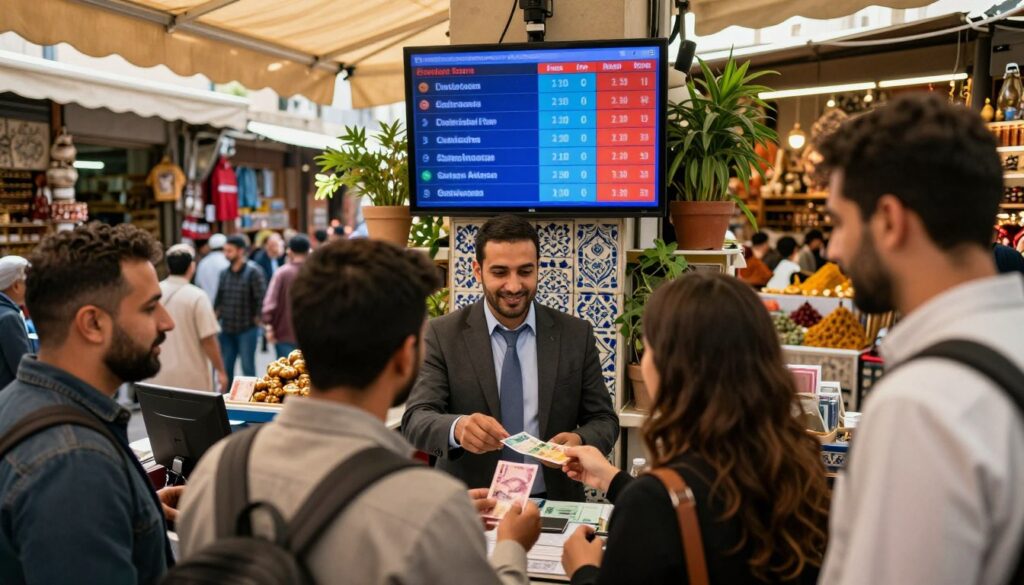
Before you arrive in Morocco, it’s key to know about the local currency, the dirham. This knowledge will make your trip smoother. Learning how to handle your money, where to exchange it, and the local tipping customs will improve your experience.
Preparing Your Finances Before Arrival
It’s wise to exchange some currency before you go to Morocco. You can also use ATMs or credit cards for buying things. Tell your bank you’re traveling to avoid any money problems.
- Check the current exchange rate to understand the value of your money.
- Consider using a currency exchange service or a bank for better rates.
- Have some local currency for initial expenses.
Best Places to Exchange Money in Major Cities
In big cities like Marrakech and Casablanca, you’ll find many places to exchange money. Official exchange offices and banks are best for safe and fair deals.
- Look for exchange offices with good reputations.
- Avoid exchanging money at airports, as rates may not be favorable.
- Use ATMs for withdrawals, as they often provide the best exchange rates.
Tipping Customs and Cash Handling
Tipping in Morocco is common, especially for tour guides and restaurant staff. Knowing the local tipping customs is important to show your appreciation right.
- Tip tour guides around 50-100 dirhams per day.
- For restaurant staff, 5-10 dirhams per service is considered polite.
- Keep some cash handy for tips and small purchases.
Common Currency-Related Scams to Avoid
Watch out for currency exchange scams, especially in tourist spots. Always check the exchange rate and stay alert.
- Avoid exchanging money with street vendors.
- Count your money before leaving the exchange counter.
- Be wary of ATMs in isolated areas.
The Role of Morocco Currency in the National Economy
The Moroccan dirham is key to the country’s economy. It affects many parts of the national economy. Knowing how the dirham works is important.
The Dirham as an Economic Policy Tool
The dirham is more than just money. It’s a tool for Morocco’s economic policies. The government and central bank use it to control the economy.
They adjust interest rates and the money supply. This helps manage the economy. For example, a weaker dirham can make Moroccan goods cheaper abroad.
Inflation Management and Purchasing Power
The dirham helps control inflation and keep prices stable. A weaker dirham makes imports more expensive, which can raise prices. But a strong dirham keeps prices down by making imports cheaper.
The central bank must balance these to protect consumers’ buying power.
Foreign Investment and Currency Stability
Foreign investors look for stable currencies. Morocco aims to keep its dirham stable to attract them. It uses policies like managed float and foreign exchange market interventions.
A stable dirham brings in more foreign investment. This helps the economy grow.
Tourism Industry and Currency Impacts
The tourism sector is also influenced by the dirham. A weaker dirham makes Morocco more appealing to tourists. This can boost tourism revenue.
But a very weak dirham can also raise costs for tourism. This might reduce some of the benefits.
The Moroccan dirham’s role is complex. It affects economic policy, inflation, foreign investment, and tourism. Understanding these connections is key to understanding Morocco’s economy.
Digital Transformation and the Future of the Moroccan Dirham
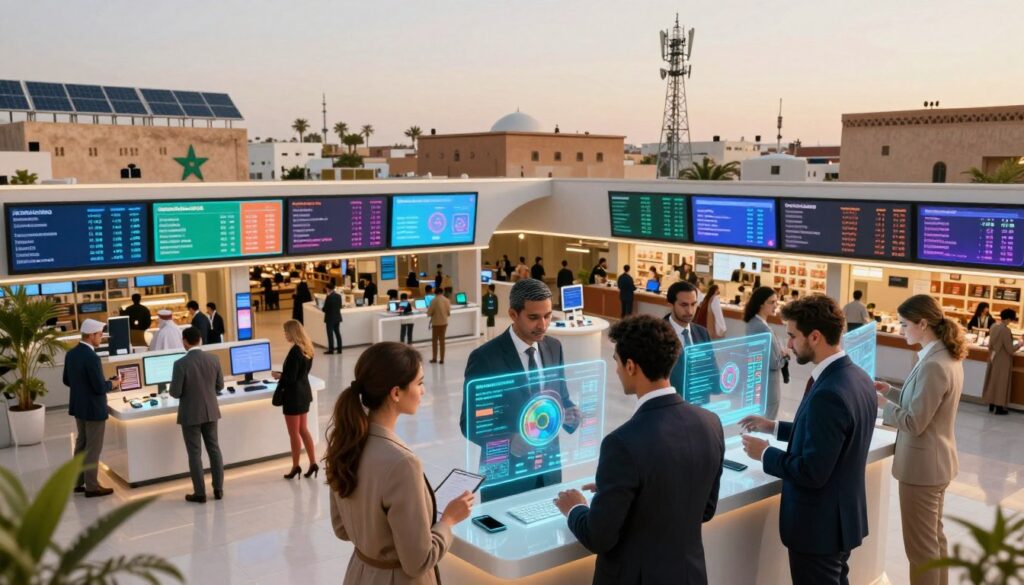
Morocco’s digital transformation is changing its financial sector, especially how the Moroccan Dirham is used. The country is embracing digital innovation, leading to big changes in how people handle their money.
Mobile Payment Growth in Morocco
Mobile payments are becoming more popular in Morocco. This is thanks to more people using smartphones and the ease they bring. Services like Mobicash and Orange Money are making it simple to do financial transactions.
This shift in mobile payments is making finance more accessible and easy for everyone. It’s also pushing traditional banks to innovate and keep up with these changes.
Cryptocurrency Regulations and Adoption
Cryptocurrency use is growing globally, and Morocco is part of this trend. Although it’s still in its early days, the government is starting to make rules.
The Bank Al-Maghrib, Morocco’s central bank, has warned about cryptocurrency risks. Yet, it’s also interested in blockchain technology. This shows a possible path for future adoption and regulation.
Central Bank Digital Currency Initiatives
Central Bank Digital Currencies (CBDCs) are becoming more popular worldwide, and Morocco is exploring them. A CBDC could make currency more efficient, secure, and stable, changing the financial system.
The Bank Al-Maghrib is researching and testing a digital dirham. This could greatly impact Morocco’s financial system and daily life.
Financial Technology Innovations
Morocco is seeing a lot of growth in financial technology (FinTech) thanks to startups and government support. These innovations include digital payment platforms and advanced banking solutions, improving the financial ecosystem.
FinTech growth is not just making finance more inclusive. It’s also opening up new opportunities for businesses and individuals. It’s a key part of Morocco’s digital transformation, aiming to make finance more efficient and accessible.
Conclusion
Understanding the Moroccan dirham is key when dealing with money in Morocco. We’ve looked into the dirham’s history and its role in the economy. Knowing about the dirham helps you manage your money, whether you’re traveling or investing.
The Moroccan dirham is more than currency; it’s a window into Morocco’s economy. As Morocco grows in the global market, the dirham’s value is vital. This knowledge helps you make smart financial choices, making your time in Morocco easier.
In short, the Moroccan dirham is crucial for Morocco’s financial scene. When you’re in Morocco, whether traveling or investing, knowing the dirham well is important. Stay updated on the Morocco currency to smoothly handle your financial dealings in Morocco.
FAQ
What is the official currency used in Morocco?
The official currency in Morocco is the Moroccan dirham (MAD).
What are the available denominations of the Moroccan dirham?
The Moroccan dirham comes in many denominations. This makes it easy for everyday use.
How is the Moroccan dirham pegged?
The dirham is tied to a mix of currencies. Mainly the euro and the US dollar.
What is the currency code and symbol for the Moroccan dirham?
Knowing the Moroccan dirham’s code (MAD) and symbol is important.
How can I exchange my money to Moroccan dirham?
You can exchange money at official offices, banks, or use ATMs and credit cards in Morocco.
What are the current exchange rate trends for the Moroccan dirham?
The Moroccan dirham’s exchange rate changes. This is due to Morocco’s managed float policy.
Can I use credit cards and ATMs in Morocco?
Yes, ATMs and credit cards are widely accepted in Morocco. This makes managing money easy.
How can I avoid common currency-related scams in Morocco?
To avoid scams, be careful when exchanging money. Use official offices and stay alert.
What is the role of the Moroccan dirham in the national economy?
The dirham is key to Morocco’s economy. It helps with policy, managing inflation, and buying power.
Are there any digital payment options available in Morocco?
Yes, Morocco is moving towards digital payments. There’s growth in mobile payments, crypto rules, and digital currency plans.
How does the Moroccan dirham impact the tourism industry?
The dirham’s value affects tourism. A stable currency can draw more investment and tourists.

Adam G
This post was created by Adam G, a seasoned financial writer with a passion for explaining currency exchange and market movements